
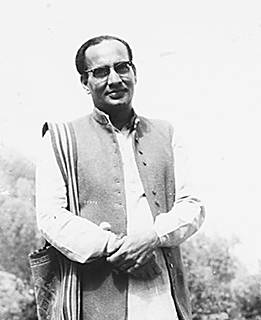
Indra Dugar
Born in Jiagunj, West Bengal in 1918, Indra Dugar was a self-taught artist unlike his father Hirachand Dugar who had a formal education in art. Dugar attended school in Santiniketan and was exposed to the artistic styles and techniques of Kala Bhavan and the Neo-Bengal School. Eventually, he overtook the Bengal School and developed a highly individualistic style of painting.
Dugar was known for his paintings of rustic outdoor scenes, painted in a non-academic style, but retaining the harmony of color to reflect the tranquility of his subject matter. He learned to structure his landscapes from Nirode Mazumdar and Rathin Moitra, and from his father, he inherited the tradition of painting on silk. Watercolor and tempera were his preferred media. Dugar earlier work relied heavily on his observations, but he gradually began to whittle down the details.
Dugar was a versatile artist. He created decorative motifs for the annual sessions of the Congress in Ramgarh, Jaipur and Amritsar, which went beyond his chosen theme of Indian landscapes. He was an art critic for the Bengali publications Desh and Anand Bazar Patrika and tried to illustrate childrenbooks. Dugar has shown his art as part of several prestigious exhibitions in India and abroad, including a UNESCO sponsored exhibition in Paris in 1946. His art is in public and private collections, including the Academy of Fine Arts, the Indian Museum and Raj Bhavan in Kolkata and the Japanese Art Association in Tokyo. In 1987, Dugar donated paintings to the Amar Mahal Museum in Jammu. He was a member of the Calcutta Academy of Fine Arts and the All India Society of Fine Arts and Crafts, New Delhi. Dugar received several awards, including a silver medal from the Calcutta Academy of Fine Arts in 1945, 1949 and 1950, and the 8th Sangeet Shyamala Prize, Calcutta, in 1986.
Indra Dugar passed away in Kolkata in 1989
BORN
1918 Jiagunj
DIED
1989 Calcutta
Exclusive Artworks
No paintings found for this artist.